


A Hole In Space
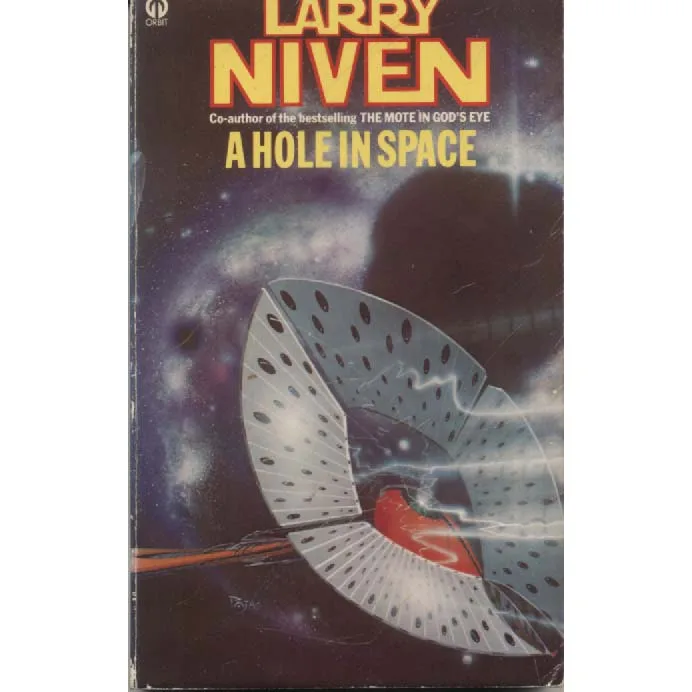
Publisher: Futura
Format: Paperback
ISBN: 0860078531
A hole in space sounds like the sort of defect that ought to be reported immediately to whoever installed the universe. In Larry Niven’s hands, however, it may be a teleportation system, a microscopic black hole, an alien device or simply the opening through which a perfectly respectable scientific idea escapes and becomes dangerous.
A Hole in Space collects nine short stories and one essay, ranging across teleportation, suspended animation, alien artefacts, artificial worlds and the lethal consequences of being technically correct in front of an irritating superior. Niven approaches science fiction as a vast experimental workshop: first establish a plausible idea, then allow human beings to misuse it with the confidence naturally produced by incomplete understanding.
“Rammer” begins with the consciousness of a man who has spent centuries in frozen storage being transferred into the body of a condemned criminal. The authorities expect him to accept his new identity and perform a useful assignment. He has other ideas, demonstrating that if you revive an ancient political organiser inside a healthy body, you should not be surprised when he immediately begins organising his escape. The story later became the opening of Niven’s novel A World Out of Time.
“The Alibi Machine” and “The Last Days of the Permanent Floating Riot Club” explore the social consequences of instantaneous transport. Teleportation makes distance almost irrelevant, which sounds splendid until crime, wealth and human nuisance are also liberated from geography. The very rich can move their parties continually around the world, avoiding local laws, neighbours and the possibility that anybody might finally ask them to leave.
In “All the Bridges Rusting,” an apparently straightforward piece of machinery conceals a considerably larger mystery, while “There Is a Tide” features Louis Gridley Wu confronting an alien and an opportunity that may be rather less accidental than it appears. Elsewhere, “$16,940.00” considers the awkward commercial value of scientific knowledge when applied by somebody with a practical understanding of gold, markets and how quickly an economy can object.
“The Hole Man,” winner of the Hugo Award for Best Short Story, follows an expedition exploring an ancient alien base on Mars. One scientist believes a machine contains a microscopic black hole; his superior responds with sustained mockery. When the containment field is switched off, the disputed object begins falling towards the centre of the planet, passing through whatever happens to be in its way. It is a brisk demonstration of why management should occasionally allow technical staff to finish a sentence.
“The Fourth Profession” concerns alien visitors distributing pills that implant specialised knowledge directly into the brain. This offers a wonderfully efficient educational system without tuition fees, lectures or revision. Unfortunately, the recipients may not understand exactly what they have learned, why the aliens taught it to them or what larger purpose is being served. Even in the future, free training frequently arrives with terms and conditions.
The nonfiction piece “Bigger Than Worlds” examines possible habitats larger than planets, including generation ships, orbital structures and other feats of cosmic engineering. Niven treats the available universe as a property developer might regard an unusually spacious plot: full of opportunities, structurally challenging and clearly in need of something enormous being built upon it.
Originally collected in 1974, these stories show Niven at his most inventive, playful and technically mischievous. Some belong to his Known Space universe while others stand independently, but all share his fascination with taking one speculative idea seriously enough to discover its least convenient consequences. The future is full of miracles; regrettably, they will be operated by people.
This 1980 Futura edition is in Good condition. It shows ordinary signs of previous reading but remains sound, complete and free from microscopic gravitational punctures. Any actual hole found in the book should be regarded as a condition issue rather than an advanced transport system.
Sold by Crappy Old Books, where teleportation is not currently available and purchases must still travel through the disappointingly continuous space between our premises and your letterbox.
Keep browsing: See more Science-Fiction books Other books by Larry Niven
